

What is the Difference Between EMF Testing and EMR Testing?
What is the Difference Between EMF Testing and EMR Testing?
By James Finn ©2014, edited ©2026
For those few brave and informed people who are first learning about electromagnetic radiation, although technically incorrect, the common vernacular, due to the internet, is EMF (Electromagnetic Field Radiation), and EMR (Electromagnetic Radiation) are pretty much the same.
But if you want to go deeper, please read on.
EMF and EMR are often conflated.
EMF (electromotive force) is the electrical potential (voltage) a moving magnetic field or electrochemical battery produces in physics. EMF equals the reactive potential difference between terminals (connection points) when electrical current is not flowing over a conductor. The typical formula for Electromotive Force is: E = W/Q (where E = the electrical potential difference between terminals; W = Work done moving a charge from one point to another; Q = Quantity of charge in coulombs).
This formula relates to Lenz’s Law: Lenz's Law states that a magnetic field induced by an electrical current produced by a change in magnetic flux (Faraday's Law) counters the change in flux. In other words, a changing magnetic field can produce an electric current, and conversely, an electric current can produce a magnetic field. Here, is a simple formula that explains this clearly; EMF = ΔΦ/Δτ (where Δ = change, Φ = flux, τ = time)
In measuring and mitigating non-ionizing radiation, EMF has come to mean electromagnetic field radiation, sometimes abbreviated as EMR or electromagnetic radiation. Electrical engineers will abbreviate this as EM.
When conducting electromagnetic field (EMF) testing, the context of the request, our client's purpose and goals, and the electromagnetic environment or equipment under test (EUT) will indicate the specific what, when, how, and why we will measure.
Electromagnetic fields are usually measured as either (1) single-axis measurements rotationally orientated on a three-dimensional model, a method used when accuracy and precision are required to ascertain as much detail as is possible, or (2) a real-time three-dimensional triaxial X, Y, Z vector array measurement using either:
True Root Mean Square = true-RMS = √((X² + Y² + Z²) ÷ 3) “3” can be substituted by n, the number of ordinates.
Magnitude of the Vector(XYZ)= VM = √ (X² + Y² + Z²)
Magnitude of the Vector Sum* = VSM = √( X²Real +X²imag + Y²Real + Y²imag + Z²Real + Z²imag) ÷ n)
imag (imaginary number) as z = (a + bi)
a = Real x-axis, bi = complex imaginary y-axis number determined by the polarity coordinate components
(Usually, these calculations are provided within your meter’s programming or software. I wrote these formulas so that you can easily calculate these measurements with only a single-axis Gaussmeter or magnetic sensor probe. They are typed the same way you would type the formulas into your Texas Instruments calculator.)
A triaxial Magnitude of the Vector (XYZ), calculated within the Gigahertz Solutions NFA 1000 Near-Field Analyzer, is used for a quick and functional assessment by Professional Electromagnetic Radiation Specialists. They are often tasked with identifying emission source points and assessing a field's size, shape, frequency, and magnitude. They then recommend various remedial options to clients for “good, better, and best” solutions to mitigate localized radiation levels.
EMF Testing involves unbiased measurement of an electromagnetic field's power density, flux magnitude, frequency range, size, and shape. Often, one should consider time and magnitude derivatives. The strength of an electromagnetic field generally decreases with distance from the point source. This rule of thumb can deviate with reflection rates and dense multipath co-signaling. The field's energy increases proportionally to the frequency (Planck's Law). The rate of frequency fluctuation and phase noise (jitter) also factor into the assessment equation.
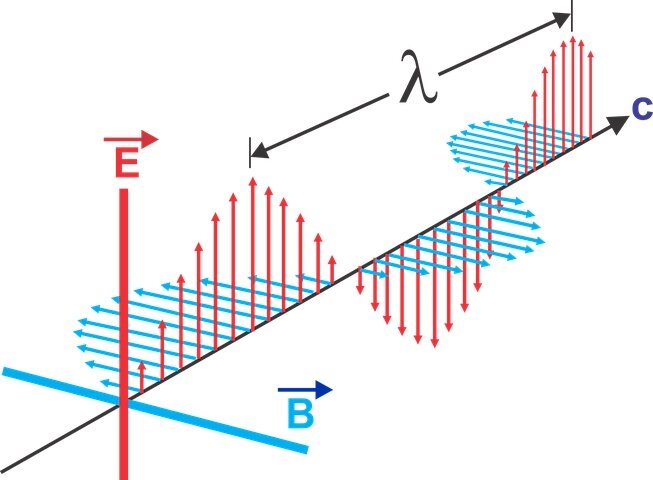
E = electromotive force, B = magnetic induction and direction of the magnetic rotation, λ = wavelength, c = particle moving at the speed of light / total electric current and its direction
An electromagnetic field unifies charged particles with a corresponding magnetic flux, forming a wavelength that vibrates at a frequency or a band of frequencies. Interesting effects seldom mentioned are that all EMFs emit light, either visible or invisible, and sound, either audible or inaudible.
An AC magnetic field with a frequency just above the electricity frequency in your home (60 Hertz in the USA and Canada, 50 Hertz in most of the world) is used to communicate with submarines and other submersibles. Signals can penetrate saltwater 10,000 feet below sea level and into the ionosphere. Nuclear radiation is contained by both seawater and the ionosphere. This ability is why ELF (Extremely Low Frequencies) is used for communication through challenging media such as water, concrete, and Earth. Another rule of thumb is that the lower the frequency, the more characteristic the field penetration.
Many physicists begin a general introductory lecture on EMR, electromagnetic radiation, by distinguishing how electromagnetic forces can affect an atom. Ionizing radiation, or nuclear radiation, can change an atom by providing enough energy to detach one or more electrons from it. Non-ionizing radiation does not detach a particle from an atom but can split an electron’s spectral lines, affecting its quantum orbit and spin.
When most people think of radiation, they think of nuclear radiation, such as X-rays and gamma rays, which are ionizing radiation that can penetrate the human body and, at high doses, cause harm. The term dosage level is often used to refer to flux or power density in this context. Most people do not realize that much of the non-ionizing portion of the electromagnetic spectrum, whether DC or AC, can penetrate the human body to some degree, with the amount of exposure depending on the radiation flux, frequency, and duration.
At the atomic level, non-ionic radiation can cause shifts in an electron's quantum orbit; the electron's spin, or both, in an electrical conductor can generate noise or transient harmonics. Etiam, the changing of an electron's quantum orbit, the electron spin, or both inside an atom of a biological cell, is where we see how living cells can be affected. One natural result is the reversal of a cell's polarity, causing cells to relinquish electrons, oxidize, shift from alkaline to acidic conditions, sometimes becoming inflamed, mutate, or even undergo premature apoptosis (cell death).
Our general observation from countless assessments indicates that factors such as gender, body mass, age, and health status should be considered when discussing dosage tolerance or determining reference dosimetry. Women tend to be more sensitive to the effects of electricity/ electromagnetism than men. (This may be because women’s bodies generally contain more water content by the relative percentage of body mass than men’s bodies. We do not know why, but more than 60% of those complaining about EMF sensitivity to us have been women.) Many people present with sensitivity symptoms have Lyme disease, chemical sensitivities, multiple allergies, or are prone to sunburn easily. Persons with prior exposure to extreme levels of electromagnetic radiation for an extended period often complain of developing sensitivity to EMF. Finally, the elderly and the frail also appear to be highly sensitive. We never doubt someone’s claims of being sensitive to EMF, but there have been a few occasions when a client has shown inconsistencies. There may be various EMF sensitivities, with some folks only sensitive to a specific frequency bandwidth. If this is the case, the prevailing theories on characteristic EMF sensitivity should be reconsidered. That said, much more scientific work is needed in this study area.
Although a person with a larger mass will register a higher epidermal voltage than someone with a lesser mass standing in the same spot, those with a larger mass tend to feel less affected by electromagnetism. Children and older adults seem more affected by strong radiation levels than teenagers and young adults, especially regarding magnetic fields and the magnetic component of radiofrequency radiation. Dosage levels for non-ionizing radiation are often used, but this practice is often frowned upon due to the disparate scientific literature. (Disparate only because of “bad” science, in my opinion.) Of course, DC and AC non-ionic radiation can cause electromagnetic interference to sensitive electronic equipment.
Another possible result of over-exposure to electromagnetic radiation (engineered or native EMF) is an effect on protein receptors and electrical signaling channels in cellular pathways, such as calcium ion (Ca2+) motility, potassium (K+) channels, and transduction pathways in neurons.**
* The Vector Sum Method is used in physics calculations and some modeling programs, such as SimuTech, where imaginary numbers are employed to consider the vector phase.
**Cited from works by Dr. Martin Pall.
Note: The “o” in µo, mu-naught, should be a subscript, not a full-size “o.” Our website platform does not accommodate subscripts.